
Many couples plan to have a baby but face difficulty in conceiving. Medical science now offers different fertility treatments that help couples become parents. Two commonly used treatments are IUI (Intrauterine Insemination) and IVF (In Vitro Fertilisation).
Both treatments aim to help fertilisation between egg and sperm, but the method and success rate are different.
Understanding the difference between IUI vs IVF helps couples choose the treatment that suits their condition.
What is the difference between IUI and IVF?
IUI (Intrauterine Insemination) places prepared sperm directly into the uterus so fertilisation happens inside the body. IVF (In Vitro Fertilisation) collects eggs from the ovaries, fertilises them with sperm in a laboratory, and then places the embryo in the uterus. IUI is simpler and lower in cost, while IVF has a higher success rate and is used for more complex fertility problems.
What is IUI Treatment?
IUI (Intrauterine Insemination) is a fertility treatment where sperm is placed directly inside the uterus around the time of ovulation.
In natural conception, sperm must travel from the vagina through the cervix and uterus to reach the egg. During IUI, doctors shorten this journey by placing prepared sperm directly into the uterus.
This improves the chance that sperm reaches the egg.
Steps in the IUI Procedure
Ovulation Monitoring
Doctors track ovulation using ultrasound.
Sperm Collection
A semen sample is collected from the male partner or donor.
Sperm Washing
Healthy sperm are separated from the sample in a lab.
Sperm Placement
Using a thin catheter, sperms are placed inside the uterus.
The entire procedure usually takes 5–10 minutes and does not require anesthesia.
What is IVF Treatment?
IVF (In Vitro Fertilisation) is a more advanced fertility treatment.
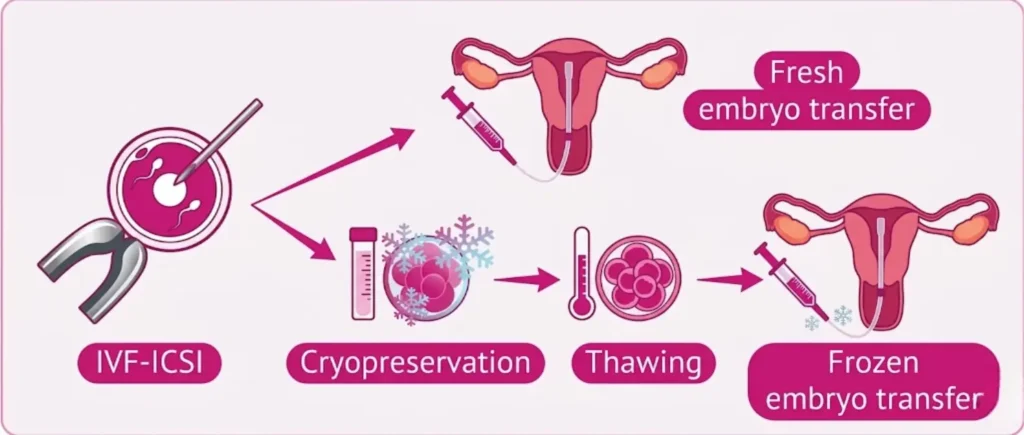
In IVF, fertilisation happens outside the body in a laboratory. Doctors collect eggs from the ovaries and combine them with sperm to form embryos. One or two healthy embryos are then placed into the uterus.
IVF is used when natural fertilisation inside the body becomes difficult.
Steps in the IVF Process
Ovarian Stimulation
The woman receives hormonal injections for around 8–12 days to help multiple eggs grow in the ovaries.
Egg Retrieval
Doctors collect mature eggs using a thin needle guided by ultrasound. This procedure is done under mild sedation.
Fertilisation in Laboratory
Eggs and sperm are combined in a laboratory dish so fertilisation can occur.
Embryo Development
The fertilised eggs grow into embryos for a few days.
Embryo Transfer
A healthy embryo is placed inside the uterus using a thin tube.
Difference Between IUI and IVF
The main difference between IUI and IVF is where fertilisation happens.
ICSI and IVF Treatment
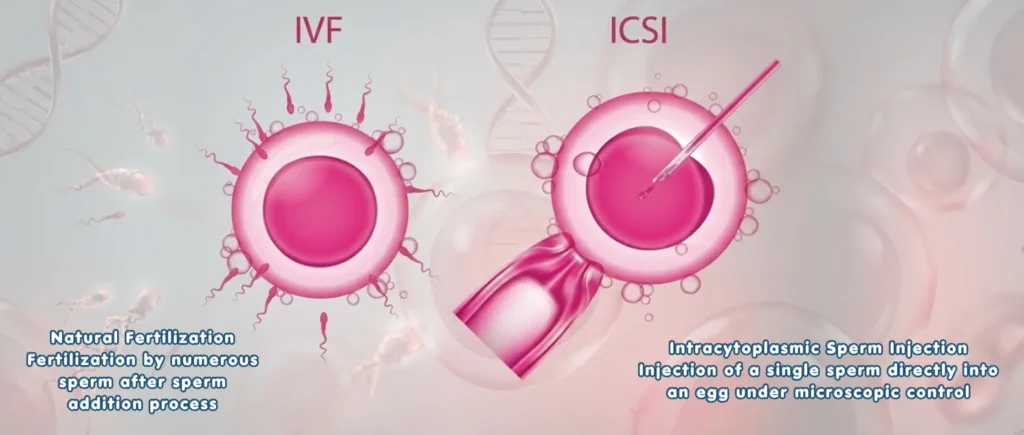
In ICSI (intracytoplasmic sperm injection) method, a single sperm is directly injected into a mature egg using a microscope.
IVF vs ICSI
IUI vs IVF Success Rate
Success rate is an important factor when choosing fertility treatment.
Average Success Rate per Cycle
| Age Group | IUI Success Rate | IVF Success Rate |
|---|---|---|
| Under 35 | 15–20% | 55–60% |
| 35–40 | 10–15% | 45–50% |
| Above 40 | 5–8% | 25–30% |
IVF generally has a higher success rate because fertilisation happens under controlled laboratory conditions.
However, success also depends on:
- Age of the woman
- Egg quality
- Sperm quality
- Cause of infertility
- Overall health
Advantages of IUI Treatment
IUI offers several benefits for couples starting fertility treatment.
However, the success rate is lower compared to IVF.
Advantages of IVF Treatment
IVF provides more medical control during fertilisation.
Risks of IUI and IVF
IUI Risks: Multiple pregnancy if fertility medicines are used, mild cramping, infection (rare).
IVF Risks: Ovarian hyperstimulation syndrome (OHSS), multiple pregnancy, emotional stress during treatment.
Doctors carefully monitor patients to reduce these risks.
Which Treatment is Better: IUI or IVF?
There is no single treatment that suits every couple. The choice depends on several medical and personal factors.
The right treatment depends on: Cause of infertility, Age of the woman, Duration of infertility, Medical history.
Cause of Infertility
IUI may help in unexplained infertility, mild sperm issues, or ovulation problems. IVF is usually recommended for blocked tubes, severe male infertility, endometriosis, or failed IUI.
Age of the Woman
Women under 35 may first try IUI. Above 35, doctors often suggest IVF sooner.
Duration of Infertility
Less than two years → IUI may be tried; many years → IVF is often more suitable.
Medical History
Blocked tubes, repeated pregnancy loss may require IVF.
Budget for Treatment
IUI costs less; IVF involves lab procedures and higher cost.
Doctors usually start with simpler treatment like IUI and move to IVF if pregnancy does not occur.
Speak With a Fertility Specialist
Choosing the right fertility treatment becomes easier with proper medical guidance. A fertility expert can evaluate test reports and explain which option may be suitable for your condition.
If you have questions about IUI, IVF, or other fertility treatments, you can connect with the clinic to receive professional guidance and understand the next steps toward planning your pregnancy journey.
Frequently Asked Questions
How many IUI cycles should be tried before IVF?
Doctors usually recommend trying 3–4 IUI cycles. If pregnancy does not occur, IVF may be suggested.
Is IVF always successful?
No fertility treatment guarantees pregnancy. Success depends on age, egg quality, sperm quality, and the cause of infertility.
Can IUI be done for severe male factor?
IUI is not usually effective for severe male infertility. IVF with ICSI is often recommended.
Final Thoughts
Both IUI and IVF are effective fertility treatments that help couples achieve pregnancy.
IUI is a simpler method that works well for mild fertility issues. IVF is a more advanced treatment with higher success rates and is useful for complex infertility conditions.
A fertility specialist can evaluate medical history, tests, and age to suggest the most suitable treatment.
Early consultation and proper guidance can help couples move closer to their goal of starting a family.